


I spent my Monday morning the same way most VPs of Marketing do: staring at fourteen open browser tabs, three different single sources of truth that tell a different story, and a notification that one of our API keys had expired, breaking a critical lead-flow automation.
By noon, I realize I'm not a Marketing Leader anymore. I am a high-priced glorified data-janitor. Look mom, I made it!
Getting drunk on the SaaS Kool-Aid
We’ve been sold a lie for the last decade. The lie was that best-of-breed SaaS would set us free. We were told that for every friction point in our business, there was a $50-per-month-per-seat solution waiting in the cloud.
So, we bought them all. We bought the SEO tool, the social scheduler, the intent data platform, the project management suite, and the engagement layer that sits on top of our CRM. Not all at once, but slowly over time, the tech stack grew out of proportion.
The result? We didn’t buy efficiency. We bought a Franken-stack. A disjointed, expensive, and rigid mess of tools that don’t talk to each other, don't fit our specific workflow, and cost more in human context-switching" than they save in automation.
Every effort to centralize everything that happens into one clear overview fails miserably. The journey is always the same: I ascend on Mount Stupid, thinking I’ve cracked the code, only to fall down to my demise, listening in agony to our Director of RevOps saying, “Hate to say I told you so.”
Working at an AI App Gen Platform, it hurts my soul to admit I run half my Marketing operations in an Excel spreadsheet.
The death of the average solution
The fundamental problem with SaaS is that it is built for the average customer. To be profitable, a software vendor has to build a product that 10,000 companies can use. But your marketing strategy shouldn’t be average. Your lead-scoring logic, your content distribution engine, and your customer lifecycle are - or should be - unique to your organization.
When you buy a generic tool, you are forced to bend your business process to fit the software’s limitations. That works for the first 60%, but in no time, you find yourself tweaking things that aren’t built to bend. You find yourself saying things like, "Well, the CRM doesn't let me tag messaging angles in the way I need, so I’ll just use a spreadsheet on the side."
Suddenly, your automated workflow is held together by manual exports and n8n reroutes that break if someone breathes on them the wrong way. We are paying for the privilege of friction. We pay for 100% of a tool's features, use 15% of them, and then spend 40% of our week trying to bridge the gap for the 5% of functionality that is actually unique to our business.
The ROI isn't just diminishing, it's spiraling into the red. And I’m having a harder time each day justifying the spend to our CFO. Truth be told, I have a harder time justifying it to myself as well.
The rise of the accidental developer
Working at Betty Blocks, I’ve been preaching the citizen development gospel for almost eight years, but never built an app from start to finish. I understand app development, but app logic just didn’t click. Also, it took far too long, and I lost interest in building the UI part.
But something has changed. Lately, I’ve stopped looking for new vendors and started building. Not because I picked up a new development hobby, but because building is now faster and easier than diving into the deep end to find a SaaS solution that just doesn’t cut it.
I’m no anomaly. I've had a front-row seat to this shift, and I’m seeing it across my entire peer group. VPs of Marketing, Ops Directors, and Growth Leads are becoming "Accidental Developers."
We aren't writing syntax; we are describing logic. We are using AI to generate the foundational structures of apps and using low-code interfaces to drag-and-drop our way to a perfect UI. The entry point is so low now that the "I'm not a tech person" excuse is dead. If you can describe your problem, you can build your solution, and as a result fire your techstack.
Turning problem owners into problem solvers
The most transformative part of this isn't just the cost savings, it’s the adaptability. Standard SaaS is rigid. If your strategy pivots, you have to hope your software vendor pivots too. With a custom-built app, your software is liquid. It flows into whatever shape your business takes.
If we decide to change our attribution model on Tuesday, I don't have to wait for a software update. I change the logic in my custom app on Wednesday. A year ago, this was still a bridge too far, even in low-code. Now with AI, I just run with it.
We are moving away from "static tools" and toward "just-in-time" software. Need a specific dashboard for a 6-week product launch? Build it. Use it. Throw it away or evolve it when the launch is over. This is the ultimate competitive advantage: the distance between a business idea and a functional tool has shrunk from months to minutes.
Our tools are finally starting to work for us, rather than us working for our tools.This also means that the tools that don’t work for us, because they lack adaptability, are out the door.
When I talk to other marketing leaders, the sentiment is the same: SaaS fatigue is real. The "SaaS Winter" is coming, but it’s not because companies are running out of money. It’s because we are reclaiming our agency.
We are tired of the "Integration Lie". the promise that everything will work together seamlessly, only to find out that "seamless" actually means "requires a $20k implementation consultant."
We are realizing that we can consolidate. Instead of 50 different logins, we need one platform where we can build 50 different solutions.
So, what happens in 2026?
As we move into the next year, I predict a massive "unbundling" of the marketing stack.
- The Middle-Tier Purge: Middle-of-the-road point solutions. Those $50/mo tools that do one specific thing (like basic social scheduling or simple form building) will go extinct. Why pay for them when an AI-powered custom app can do it for free within your own ecosystem?
- The Platform Pivot: We will see a shift in budget from "Subscriptions" to "Enablement." Leaders will spend less on licenses and more on platforms that allow their teams to build their own internal workflows.
- The New Marketing Hire: The most valuable person on a marketing team won't be the one who knows how to use HubSpot or Salesforce. It will be the "Builder"; the person who understands business logic and can use AI and low-code to architect custom solutions on the fly.
The era of bloated, expensive, and disconnected SaaS is over. It was a necessary stepping stone, but it’s become a treadmill that’s keeping us from doing our best work.
In 2026, the winners won't be the ones with the biggest tech budgets. They will be the ones with the highest build velocity. I’m firing my tech stack, one generic tool at a time. I’m building something that actually works for me.
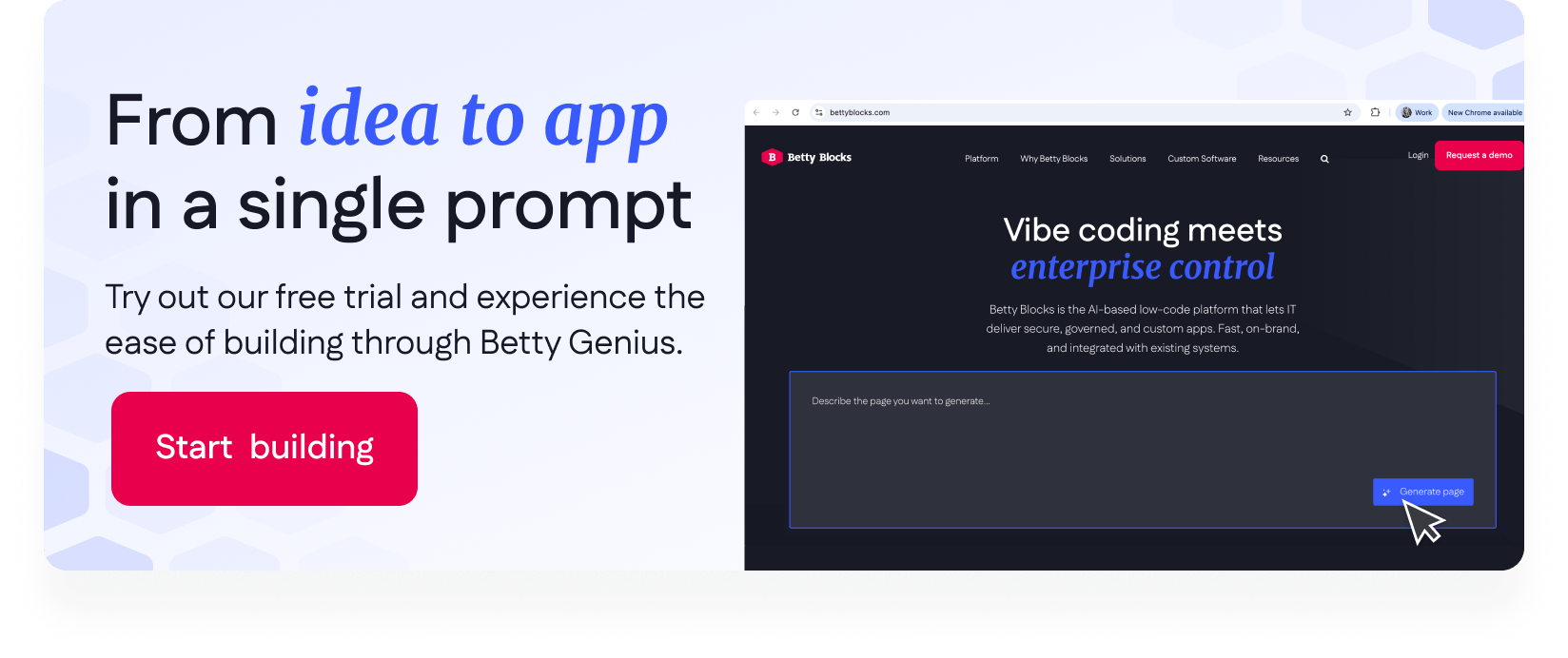
Ready to fire your own techstack? Build your first version in minutes:
