


The longer I work in IT, the clearer it becomes: Vendor lock-in is not so much about the recurring annual pricing tag, but much more about being so heavily invested in a system that walking away feels like robbery. Sure, you’ll save a ton of money by replacing your system and even by optimizing systems, but what about the millions of dollars you spent on making the system work? The years of effort, the optimization consultants, and the manual work around customization. Poof, gone.
Congrats, you’ve found yourself in a classic case of sunk cost fallacy.
The cold reality of sunk costs
In economics, a sunk cost is any expense that has already been incurred and cannot be recovered. It’s gone. It’s the "spilt milk" of the business world. Rational decision-making suggests cutting your losses and moving on. But we’re not rational; we’re highly emotional, and this wires us to get hooked by the sunk cost fallacy. At its core, three drivers keep us hostage:
- Loss aversion: We feel the sting of losing twice as hard as the joy of gaining. Quitting feels like admitting a loss. Playing into loss aversion and scarcity is one of the oldest tricks in the Marketing book for this reason.
- The waste-not trap: We’re conditioned from childhood to "finish our plate." We treat abandoning a failing project as "wasteful," even if the most wasteful thing you can do is spend another second on it. This is where the sunk-cost fallacy lock-in occurs. With each additional day, the ‘waste’ increases, making it even harder to leave.
- Reputation management: We’d rather go down with the ship than admit we’ve invested in the wrong place. This is not so much a rational choice, but more emotionally-driven behaviour where we think luck is on our side and this time we’ll be right.
In almost all cases software isn’t the problem, it’s our attitude to software. We’ve turned "staying the course" into a virtue, even when the course leads directly off a cliff. At the current pace, where AI is accelerating the game, staying the course is a trap that’s harder to escape each day. Especially mature organizations with a lot of red tape find themselves stuck, and here’s the twist: most are unaware they are even in this trap in the first place.
The anatomy of the trap
To get out, you have to understand how the trap was built. It’s constructed of three distinct layers: Financial illusion, the political shield, and the operational paralysis.
1. The financial illusion
You are trapped in a feedback loop of your own making. Most leaders stare at the price tag of a new solution and flinch, falling headfirst into the sunk cost fallacy. They think they’re being fiscally responsible by "protecting" the millions already dumped into a legacy core, but they’re actually just paying protection money to a ghost.
The only way to escape the trap is to perform a cold-blooded audit of your future, not your past. The opportunity tax - the revenue you lose every time the system says "no" to a new opportunity - is the silent killer that doesn't show up on a P&L until it's too late. If you’re spending $2M a year just to keep a $10M ERP system on life support, you’ve already paid for the new system
Stop looking at what you’ve spent and start looking at what it’s costing you to stay still. What’s the cost of doing nothing? Zero-based thinking is the only exit: if you didn’t have this ERP today, would you spend a single dime to buy it? If the answer is no, then stop paying the tax and kill the machine before it kills the company.
2. The political shield
In most organizations, modernization is a dirty word because it implies that the previous decade was a mistake. The person who championed the current system is often still in the building and made some career moves as well. Maybe they’re the CFO now. Maybe they’re the Sales Manager. To admit the system is a failure is to admit they made a mistake. So, the organization builds a political shield around the legacy system.
As a VP of Marketing, I see this in the data. I’m stuck with outdated systems and properties that are connected via spagetti reroutes that nobody understands besides the Sales Manager that left years ago. The problem is clear, the solution is hard. And so, I invest in the same sunk costs problem I’m preaching about in this article. Yeah, I know: Let him who is without sin among you be the first to throw a stone
3. Operational paralysis
Legacy systems create legacy mindsets. When your ERP is a pain to use, your employees stop trying to innovate. They start trying to survive. They develop workarounds. They use shadow spreadsheets. They stop asking "How can we do this better" and start asking "Will the system let us do this at all and why bother?"
This is the underlying problem that drove the war on talent. The 28-year-old rising star you just hired, is going to quit in six months. Why? Because they spent four years at university learning cutting-edge strategy, and you’re asking them to spend their day navigating a UI that looks like a 1980s flight simulator. You aren't just losing data; you’re losing the people who know how to use it. Even worse, you are losing the people that drive the future.
Isolate the core, build the edge
I’m not advocating to throw the entire tech stack out the window. The reality is, the majority of us are stuck with outdated systems that form the foundation of our business. What I here to advocate for is taking back your freedom, one tiny step at a time.
If you want to move the needle, you have to stop talking about systems, and start talking about freedom. The world - and especially the IT landscape - is changing each day, and what you need is the ability to rapidly adapt. Don’t think about rip and replace and multi-year overhauls, think about incrementally making changes, validating them, and optimizing.
What that means in reality is isolating the core; you let the core system run and do its thing, but don’t go above and beyond to create customization to squeeze a bit more functionality out of it. Just let it be and don’t touch it.
What you want to do is build the edge. Use the core system as a system of record, and build your tooling in a different environment. Build portals, workflows, connect multiple systems together in for example a low-code platform, and use the core as the backbone.
Let’s take JD Edwards as an example
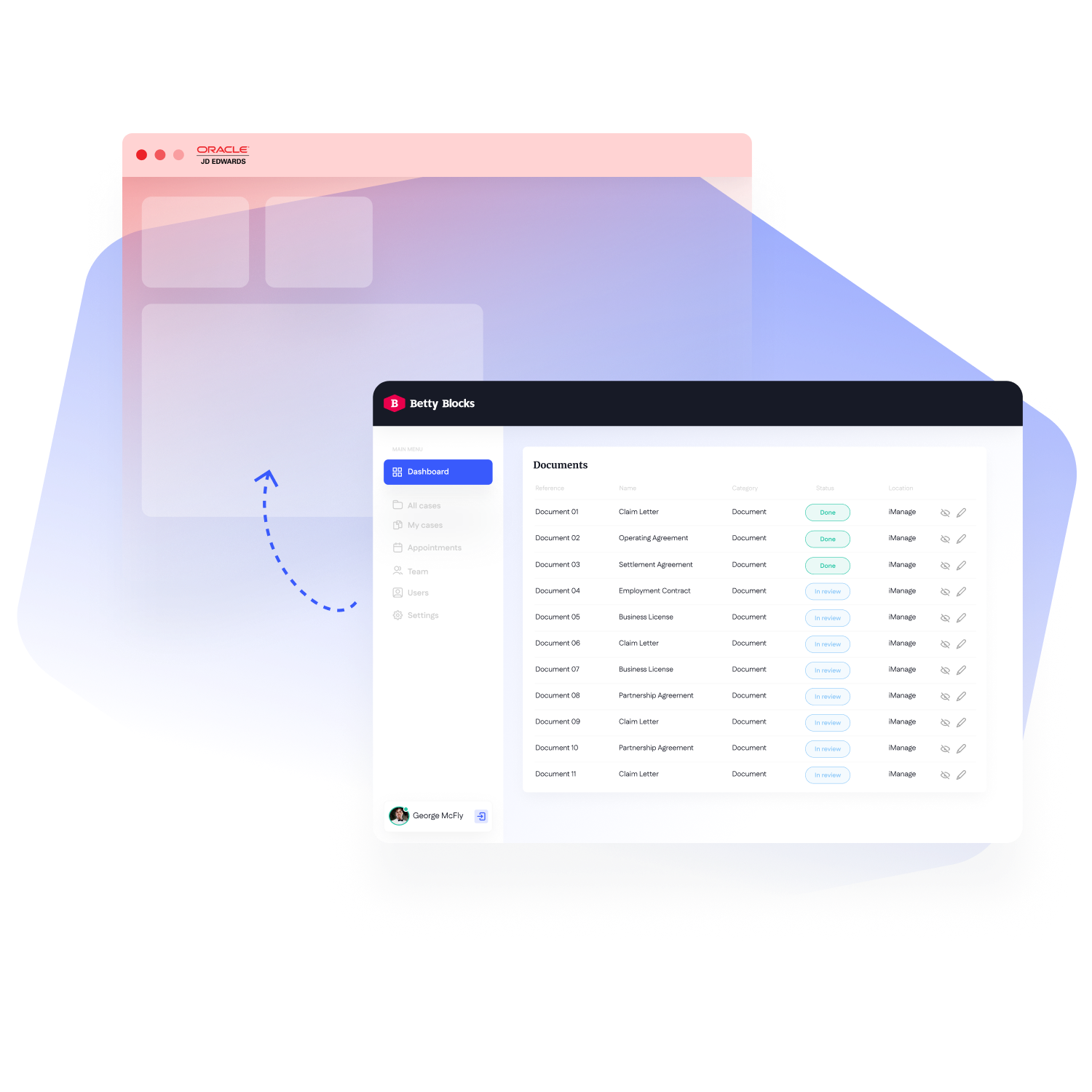
Your clients are demanding a self-service solution, but due to the limitations of your ERP, you can’t deliver. You could spend a ton of money and time in developing a solution that just doesn’t hit right, or you build the edge: You keep JD Edwards in the basement doing what it’s actually good at: holding the data (The System of Record). Then, you deploy a low-code platform to sit on top of it.
- The core (JDE): Stays silent. It just holds the "truth"; the order numbers, the inventory counts, the raw financial data.
- The edge (low-code): This is where the life is. You build a sleek, mobile-responsive portal in weeks. It "talks" to JDE via a thin API layer (like JDE Orchestrator).
- The escape: When a client logs in to see their case status, they aren't touching JDE. They are touching the low-code edge. The edge fetches the data, beautifies it, and adds modern features - like SMS notifications or document uploads - that JDE couldn't dream of supporting.
Escaping sunk cost in two steps
The value is undeniable; You have full freedom in building what you want, at lower cost and faster than ever, and what you build is yours, forever. No more worries that if the core gets a mandatory security update, that your custom solutions break. This is step one.
Step two is breaking the SaaS model as we know it. Things like vendor lock-in, annual recurring license fees, and cloud dependency, that are widely accepted, are breaking down, and for us it’s a logical shift that needs to happen. Paying for something you don’t use and only having access to what you have build as long as you pay, is just bananas if you ask us.
That’s why Betty Blocks is leading the way with our “Open” strategy, where we give you full ownership of your apps and a no license guarantee, and give you full freedom in where you want to run your data as well.
Curious to learn how Betty Blocks is changing the way software is build, run, and hosted? Let’s jump on call so we can give you all the ins-and-outs.
